

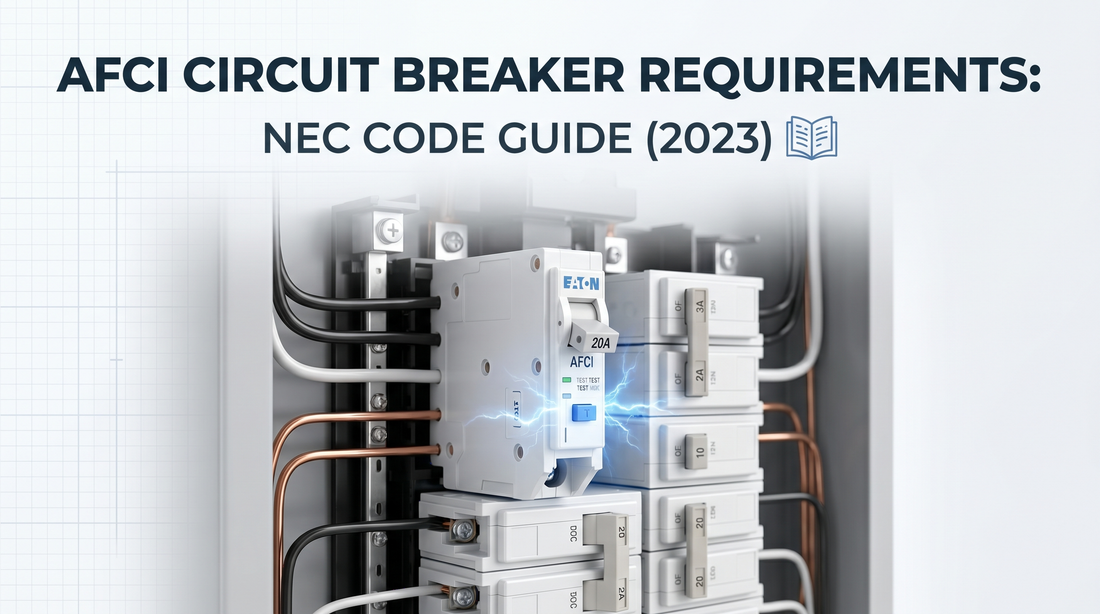
AFCI Circuit Breaker Requirements: NEC Code Guide (2023)
Arc fault circuit interrupter (AFCI) requirements have expanded significantly since they were first introduced in the 1999 NEC. If you're doing new construction, a permitted renovation, or adding circuits to an
existing home, here's exactly where AFCI protection is required today.
Current AFCI requirements — 2023 NEC
The 2023 NEC requires combination AFCI (CAFCI) protection on all 120V, 15A and 20A branch circuits in dwelling units that supply the following areas:
- Kitchens
- Family rooms
- Dining rooms
- Living rooms
- Parlors, libraries, dens
- Bedrooms
- Sunrooms, recreation rooms
- Closets
- Hallways
- Laundry areas
- Garages (some jurisdictions)
- All similar rooms or areas
In practical terms: under the 2023 NEC, every 120V circuit in a living space requires AFCI protection. The only circuits typically excluded are those in specifically GFCI-required locations (bathrooms, outdoor
circuits) — though in many cases those require AFCI as well, calling for a dual-function AFCI/GFCI breaker.
---
How AFCI requirements have expanded over time
| NEC Year | Where AFCI Required |
| 1999 NEC | Bedrooms only |
| 2002 NEC |
Bedrooms (No Change) |
| 2005 NEC |
Bedrroms (No change) |
| 2008 NEC |
All sleeping Areas |
| 2011 NEC |
Added family rooms, dining rooms, living rooms, parlors, libraries, dens, sunrooms, recreation rooms, closets, hallways |
| 2014 NEC |
Added Kitchens, laundry areas |
| 2017 NEC |
All rooms of dwelling units |
| 2020 NEC |
All 120V circuits in dwelling units |
| 2023 NEC |
All 120v circuits in dwelling units (confirmed, with expanded enforcement guidance) |
The trajectory is clear: AFCI went from bedrooms only in 1999 to virtually everywhere by 2020. If you're building new or renovating under permit, assume AFCI is required for all 120V circuits unless your local AHJ
(Authority Having Jurisdiction) specifies otherwise.
---
What "combination AFCI" means and why it matters
The NEC now specifically requires combination-type AFCI, not the older branch/feeder type. The difference:
- Branch/feeder AFCI: Detects arcing only in the panel-to-outlet wiring
- Combination AFCI (CAFCI): Detects arcing anywhere on the circuit — branch wiring, outlet wiring, extension cords, and connected devices
When purchasing AFCI breakers for NEC-compliant work, confirm the packaging says "combination type" or "CAFCI." Single-function branch/feeder type AFCI no longer meets code for new installations.
Browse combination AFCI circuit breakers (/collections/afci-arc-fault) — all models we stock are combination-type.
---
Do AFCI requirements apply to older homes?
The short answer: Only when circuits are modified or new circuits are added.
NEC requirements apply to new construction and permitted work on existing circuits. If you're replacing a breaker on an existing circuit without modifying the circuit itself, many jurisdictions don't require upgrading
to AFCI. If you're adding a new circuit, extending an existing one, or doing a renovation that involves electrical work in a bedroom or living area, the new/modified work typically must comply with current code.
However: Even if not required for existing circuits, upgrading to AFCI protection in bedrooms and living areas of older homes is strongly recommended. Homes with 20+ year old wiring are at higher risk of arc faults due
to insulation degradation — exactly the condition AFCI is designed to catch.
---
When you need both AFCI and GFCI
Some circuits fall in areas that require both arc fault and ground fault protection. For example:
- Kitchen circuits (AFCI required for living space + GFCI required near sinks)
- Circuits that pass through bedrooms and into bathrooms
For these situations, a dual-function AFCI/GFCI breaker is the cleanest solution — one device satisfies both code requirements and only occupies one panel slot.
Browse dual-function AFCI/GFCI breakers (/collections/dual-function).
 photo of "Eaton, BRP120AF, 20A, Circuit Breaker"
---
FAQ
Which code version applies to my project?
The version enforced depends on what your local jurisdiction has adopted. Most states are on the 2020 or 2023 NEC, but some are still on 2017 or earlier. Check with your local building department (AHJ) to confirm which
version is enforced in your area.
Do AFCI requirements apply to commercial buildings?
NEC AFCI requirements in Article 210.12 apply specifically to dwelling units (homes, apartments, condos). Commercial and industrial installations have different requirements. Some commercial applications may require
AFCI under other provisions, but the broad room-by-room requirements are residential.
Can I use a GFCI outlet to satisfy AFCI requirements?
No. GFCI protection and AFCI protection are completely different. A GFCI outlet detects ground faults (shock protection). It has no arc fault detection capability. You cannot substitute a GFCI device to satisfy AFCI
requirements.
My contractor says AFCI isn't required in my area — who's right?
Local code adoption varies. It's possible your jurisdiction hasn't adopted the latest NEC version yet, or has specific local amendments. The contractor may be correct for your specific location and project type. Ask
them to show you the specific code section they're referencing if you want to verify.